
Before heading on this trip, I knew little about South Dakota. I knew I wanted to visit it as part of my goal of seeing all 50 states, but I essentially considered South Dakota a flyover state, so I wasn’t in a huge rush to get there. The only spot I figured I would visit during a trip to South Dakota was Mount Rushmore. When my dad suggested this trip, we did some research and learned that the state offers so much more. This trip was one that validated my goal of seeing all 50 states. We went to see Mount Rushmore, but what we discovered is how beautiful everything else in South Dakota is.
A road trip through South Dakota means abundant wildlife, dramatic landscapes, and a feeling of utter isolation. It also means traveling deep within the American heartlands and through small rural communities where life is hard but simple, and the people are down-to-earth and friendly. The state was formerly called ‘the Sunshine State’ and it stands up to that name in a much more distinct way than the current sunshine state of Florida. Unlike the beach crowds and jovial atmosphere brought out by the sun in Florida, in South Dakota sun draws out the rich wildlife and paints a spectacular landscape in dramatic colors. I encourage you to take this road trip and discover your own reasons for falling in love with South Dakota.
How to See South Dakota
The only way to see South Dakota is by taking a road trip. There is no public transport, and the few airports are spread far apart in the state, so if you don’t enjoy road trips, this is not the journey for you. We started our South Dakota road trip from my dad’s place in Boulder, CO, which was a reasonable five-hour drive away from Custer. However, for most people, the easiest place to start your trip is in Rapid City. You can fly into the Rapid City airport, rent a car and be in the Badlands or the Black Hills within an hour or so.
When to Visit
An unofficial nickname for South Dakota is ‘the Blizzard State’. If that isn’t self-explanatory, the winter weather in the state is too severe to consider a trip of any kind. Many of the stores and restaurants in Custer close their doors starting in October when the tourist season ends. Spring and fall can also be accompanied by sudden temperature drops, wind chills, and snowstorms. The best time to plan your South Dakota road trip is a week or two before Memorial Day or a couple of weeks after Labor Day. In summer, the months of July and August can be extremely hot and filled with tourists.
My dad, sister, and I visited in mid-September and found the weather to be delightful. Although, it was still warm in most parts of the country, when we were in South Dakota, it already felt like fall. The highs during the days were in the 60s, but it got cool at night, around mid-40s. The biggest reward for going during this time of year is that there wasn’t much of a crowd, which can be an issue in the summer particularly by Mount Rushmore.
Our South Dakota Road Trip Itinerary
Day 1
We spent a large portion of our first day driving to South Dakota. Fortunately, we had enough time left during our first day to visit Mount Rushmore and Sylvan Lake in the afternoon.
Mount Rushmore- As you probably know, Mount Rushmore is a behemoth sculpture of four President heads carved into the granite face of Mount Rushmore, located among the Black Hills of South Dakota. Completed in 1941, the Memorial was planned and executed with the express purpose of bringing motorists out to South Dakota. The 60-foot sculpture includes the heads of George Washington, Thomas Jefferson, Theodore Roosevelt, and Abraham Lincoln. The monument was carved by sculptor Gutzon Borglum, with the help of his son Lincoln Borglum from 1927 to 1941. Today Mount Rushmore receives over two million visitors annually and is South Dakota’s top tourist attraction.


Sylvan Lake (Custer State Park)- Near Mount Rushmore is Custer State Park (more about the Park later on in this post). In the Park, there is a picturesque 1.1-mile walk around the lake. Most of the trail is flat, but it was a little more difficult at the halfway point when you have to climb over boulders near the dam. At Sylvan Lake, you can also opt to do water activities (e.g, kayaking or paddleboarding) or a more strenuous hike.
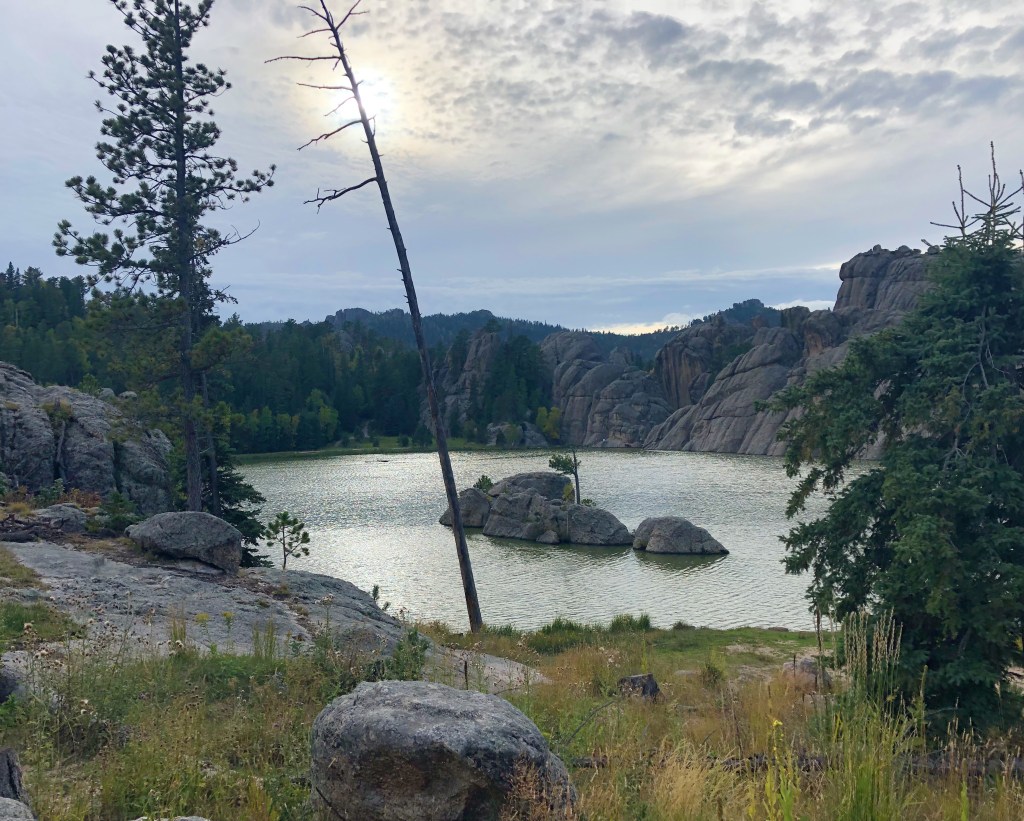
To finish off the day we ate at the Buglin‘ Bull Restaurant & Sports Bar, which ended up being delicious. I had low expectations for the food in South Dakota but was pleasantly surprised. I had the buffalo short ribs, which were fall-off-the-bone tender.
Day 2
Badlands National Park– It is a bit of a drive to Badlands National Park from Custer, about an hour and 45 minutes, but it is so worth it. Located in southwestern South Dakota, Badlands National Park consists of 244,000 acres of sharply eroded buttes, pinnacles and spires blended with the largest protected mixed grass prairie in the United States. It is desolation at its truest, where you can look for miles and see no sign of civilization.
This land has been so ruthlessly ravaged by wind and water that it has become picturesque. The Badlands are a wonderland of bizarre, colorful spires and pinnacles, massive buttes and deep gorges. Erosion of the Badlands reveals sedimentary layers of different colors: purple and yellow (shale), tan and gray (sand and gravel), red and orange (iron oxides) and white (volcanic ash).
The 30-mile long Badlands scenic drive is not to be missed. There are a multitude of stops along the route, which runs from the Ben Reifel Visitor Center along SR-240 West through the Badlands formations. You can easily spend half the day by stopping at each of the viewpoints and exploring the surrounds.
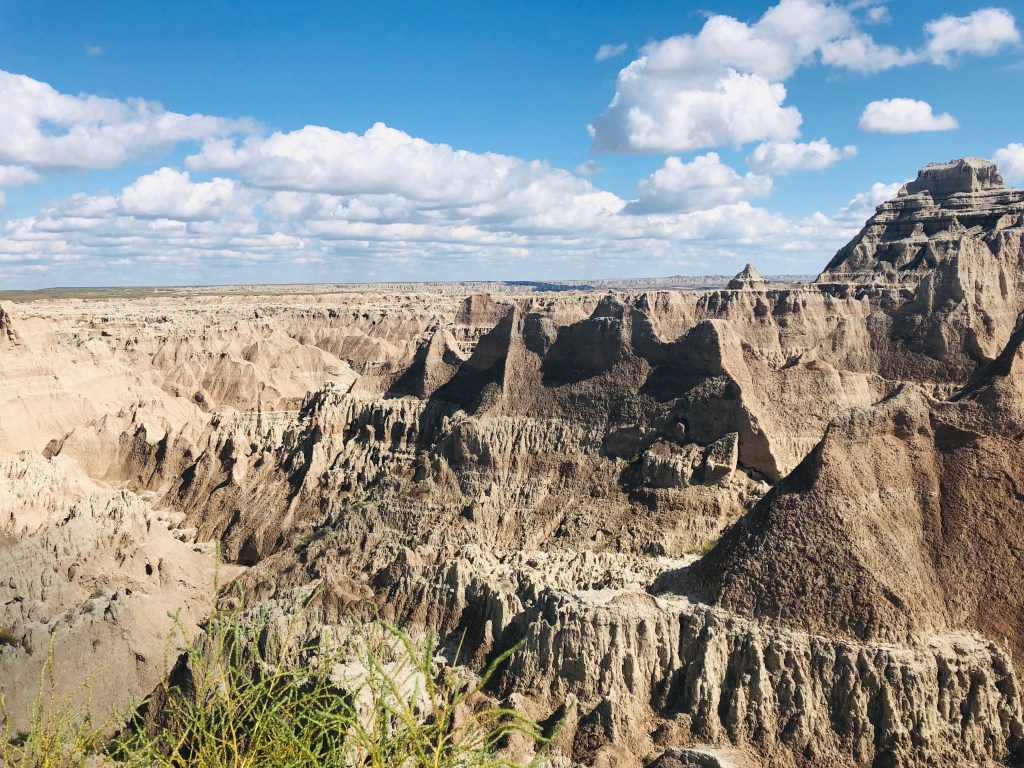

Wall Drug– When driving through South Dakota, especially on I-90, you will see many large billboards advertising Wall Drug. We all wondered what it was, so we decided to visit it on the way back to Custer from the Badlands.
Visiting Wall Drug is a fascinating experience. The quirky little roadside attraction that shouldn’t-have-turned-a-single-head-but-somehow-became-a-million-dollar-idea, is situated just outside Badland’s northern gateway. The pharmacy-come-rest stop earned much of its fame from a self-promotion scheme started by the original owners, Dorothy and Ted Hustead. Billboards advertising the establishment and “FREE ICE WATER” to thirsty travelers can be seen throughout South Dakota, its neighboring states, and as far as Morocco, Amsterdam, and London informing commuters that Wall Drug is only a few thousand kilometers away.
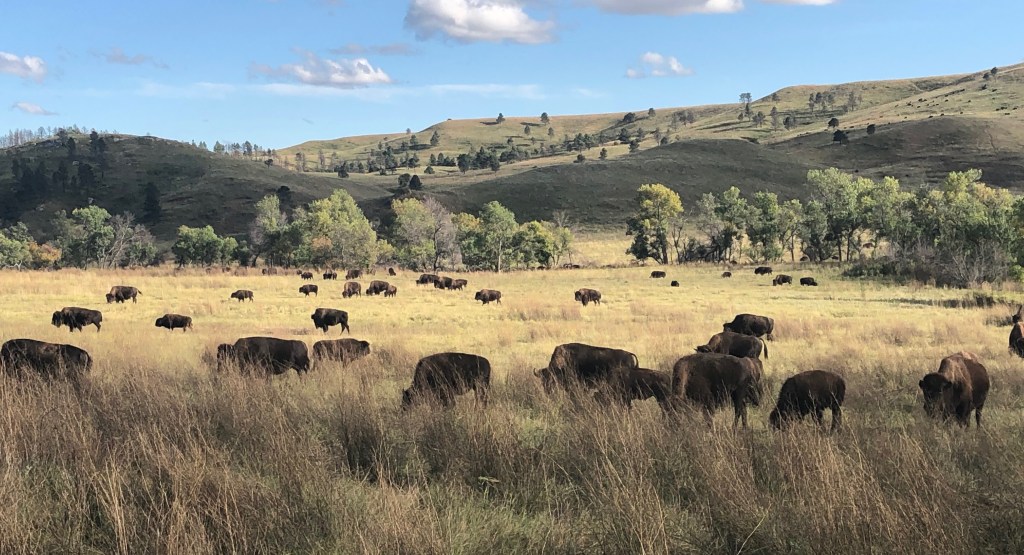
Wildlife Loop (Custer State Park)- On our drive back from the Badlands we decided to go back to Custer State Park and go around wildlife loop, which is an 18-mile loop that’s known for its wildlife viewing opportunities. Watchable wildlife in the park includes bison, whitetail and mule deer, antelope, mountain goats, elk, coyotes, burros, bighorn sheep, birds, wild turkeys and prairie dogs. The most popular animal in the area is bison. Custer State Park has a heard of 1,300 bison that wander freely around the park.
In the first half of the drive, we saw rolling prairies but no wildlife, much to our disappointment. Thankfully our luck changed around the halfway point. We were greeted by the “begging burros” who were stopped in the middle of the road, waiting to be fed. Burros are not native to the park, but these animals have roamed the expanses of Custer State Park for nearly a century. They were first used as pack animals to get visitors from Sylvan Lake Lodge up the steep path to the summit of Black Elk Peak, the highest point in the U.S. east of the Rockies. When those tourist trips ended, the working burros were released to the wild. Commonly seen on the wildlife loop, these animals are uncommonly friendly, stopping to say hello to every slowing motorist, and sneaking their heads into every auto that offers a chance for a quick snack. For the more skittish visitors who opt to keep their windows rolled up, the begging burros generally leave a slobbery mess on those same windows, but it’s nothing a little water and a squeegee won’t fix.
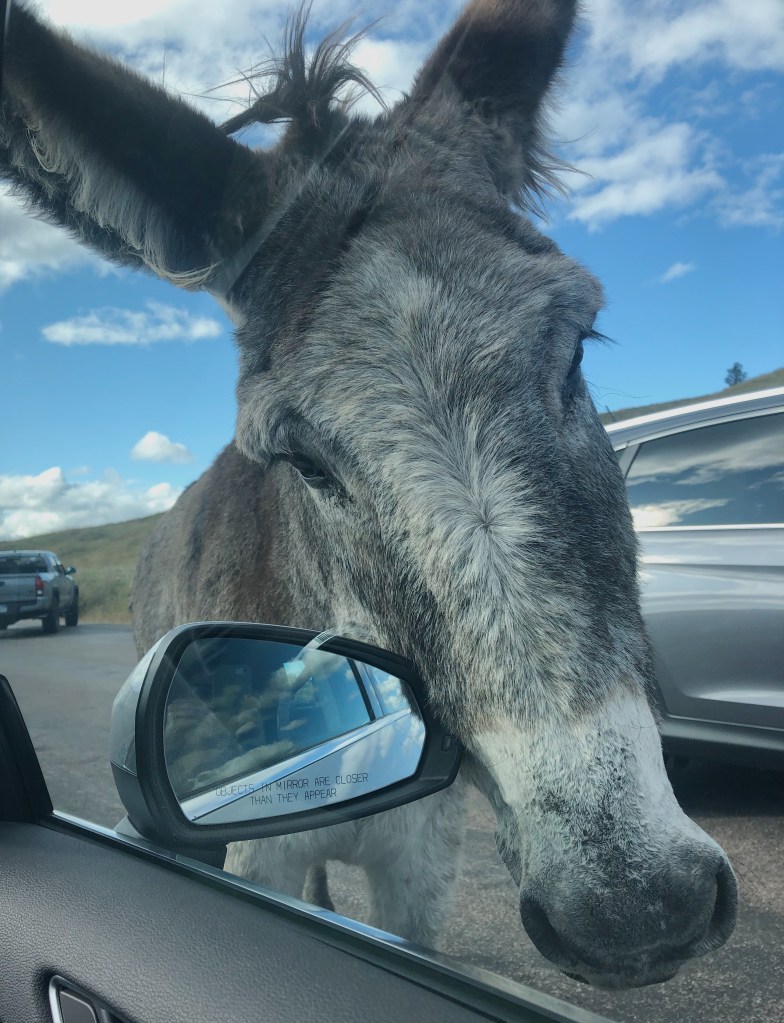
When we stopped to see the burros near the halfway point, we saw a herd of bison in the fields to our left, but they were so far away that they looked like little dots on the field. We decided to continue on the loop, but about a mile later, I became convinced that we had taken a wrong turn (somehow), so I convinced my dad to make a u-turn. It turns out that we hadn’t gone the wrong way, but since we were heading closer to our destination, we agreed that it just made sense to head back the way we came. Thank goodness we did. By the time we reached the spot where we originally saw the burros, the herd of bison had come significantly closer to the road. We stopped driving as we were surrounded by a couple hundred bison, which were moving on all sides of the car. It was truly one of the most surreal moments of my life.
On our last night in South Dakota, we ate at the State Game Lodge, which is located in Custer State Park, so is a perfect place to stop after completing the wildlife loop. We all split the rabbit & rattlesnake sausage with porter beer mustard, garlic croutons and red onion jam as an appetizer, which was delicious. For dinner, both my dad and I had the buffalo tenderloin, which was also tasty. This restaurant is overpriced, but it was enjoyable overall. It is a nice setting and you get to try some ingredients that you would not normally see.
The above suggestions are just the tip of the iceberg. There’s far more to the Black Hills and Badlands than I’ve mentioned. Do your research and find what’s most important to you then build your itinerary around those activities. If you’re on an extended road trip, you could easily spend an extra day in most of the locations I’ve mentioned here.
To summarize it quickly, I highly recommend adding South Dakota to your list of places to see. It is much more than a flyover state.
 life after five
Well done! Is Angie on your distribution list; if not I’ll forward it to her?
>
LikeLike
Wow. I never thought I’d want to visit South Dakota but after reading your beautiful and informative description, its definitely on my list!!
LikeLike